Crow & CabbageGarden Desk · Plot & Plate
A worldwide climate guide
Growing garlic
People grow garlic in many parts of the world. The type you plant, and when you plant it, depends mainly on how cold your winter is. One service also links bulb formation to day length.[8] This guide gathers advice from university and government horticulture services in several regions. Every growing fact is cited. Where sources disagree, the guide says so. Measurements are given in both metric and imperial units.
Jump to sourcesFind your local timing
Before you plant, check a local university extension, department of agriculture, or horticultural society, and look up local frost or freeze dates from a meteorological service. Use the climate groups below as a starting point, then adjust for your elevation, rainfall, and microclimate.
Core steps (all climates)
Garlic is grown from cloves (the segments of a bulb), not from true seed.[1][4] Buy named planting (seed) garlic from a garden supplier when you can. Several services advise against planting supermarket garlic, which may be unsuited to your climate or carry disease.[4][2]
- Break the bulb into cloves shortly before planting, and leave the papery skin on. Plant with the pointed end up (root, or flat, end down).[1][4][5]
- Choose the largest firm cloves. Larger cloves tend to make larger bulbs.[5]
- Plant in full sun and well-drained, fertile soil. Wet or heavy soil can lead to disease or misshapen bulbs, especially over a wet winter.[1][4]
- Depth and spacing vary by source (see disagreements below). Common figures include a clove tip about 2.5 cm (1 in) below the surface, spaced 15 cm (6 in) apart, with rows 30 cm (12 in) apart (Royal Horticultural Society, UK);[4] 5–8 cm (2–3 in) deep, 8–10 cm (3–4 in) apart, rows 15–25 cm (6–10 in) apart (Utah State University Extension);[1] and 5 cm (2 in) deep, 10 cm (4 in) apart, rows 30 cm (12 in) apart (University of California).[5]
- USU says to stop watering when the leaves start to mature (turn yellow).[1] The RHS says not to water once the bulbs are large and well formed, as this could encourage rotting; yellowing foliage is a sign the bulbs are reaching that stage.[4]
- Harvest when the tops begin to yellow or start to fall over, but before they are completely dry.[1] The RHS harvests once the leaves have turned yellow and says to carefully dig up the bulbs with a fork.[4] Minnesota Extension harvests when lower leaves are brown and about half the upper leaves are still green.[2]
- Cure (dry) the bulbs in a warm, shady or indirect-light, well-ventilated place. Curing times in the sources range from about 1–2 weeks to 2–4 weeks or more (see disagreements).[1][4][2] Then trim the tops and store in a cool, dry, airy place. Recommended storage temperatures also differ.
There are two main types of true garlic (Allium sativum). Hardneck types usually have fewer, larger cloves, a firm central stem, and often a flowering stalk (the scape), which many gardeners cut off so energy goes to the bulb; the scapes are edible if picked young. Softneck types usually have more, smaller cloves, store longer, and are often used for braiding.[1][4][2] Elephant garlic (Allium ampeloprasum) is more closely related to leek than to true garlic.[4]
Cold-winter climates
In places with a real winter, hardneck types are usually preferred because they are more cold-hardy, though softneck is also grown in some cold regions.[2][12] University of Minnesota Extension says to use types adapted to cold climates, and that typical grocery-store (often mild-climate softneck) garlic does not do well under Minnesota conditions.[2]
Plant in autumn so cloves can grow roots before the ground freezes. Minnesota Extension usually plants one or two weeks after the first killing frost.[2] Cornell Cooperative Extension advises autumn planting in areas that get a hard frost, aiming for enough time to grow roots but not so much that tops grow before freezing weather; one New York guide mentions as early as 6–8 weeks before the first expected frost.[3] The Royal Horticultural Society (UK) usually plants from mid-autumn to early winter, because most varieties need one to two months at 0–10°C (32–50°F) for good bulb development; some varieties can be planted in late winter or early spring.[4] University of California notes that in cold-winter areas, mulch can protect plants from severe cold, and that autumn planting generally makes the largest bulbs.[5]
If a flowering stem forms, cut it off so the bulb can size up.[1][4] University of Vermont Extension says garlic needs a cold treatment of about 2 months at 4°C (40°F) to induce bulbing; spring planting is possible if cloves are refrigerated first, or planted early enough to get natural cold, but spring crops often stay smaller.[13]
Mild-winter, Mediterranean, and subtropical climates
Where winters are mild, softneck types are often preferred. A University of California Master Gardener article (Contra Costa County) says softneck is better suited to warmer climates and does not need as many chill hours, while hardneck typically needs 4–6 weeks below 4–7°C (40–45°F).[12] Texas A&M AgriLife Extension in Travis County (Central Texas) reports better results with softneck in mild winters, and lists varieties such as California Early and Inchelium Red; hardneck “grows best in colder climates,” though the author says you might have some success if you refrigerate it a few weeks before planting.[9] Softneck types such as Artichoke or Creole are recommended for Florida gardens by University of Florida IFAS.[6]
Planting is usually in autumn through early winter (Northern Hemisphere months, from these sources):
- University of California: garlic is generally best planted in autumn; California regional windows include October–December in many coastal and interior areas, and September–November in the desert valleys. Those dates are approximate.[5]
- University of Florida IFAS: plant in Florida from late autumn through early winter.[6] A Pasco County IFAS article describes growing garlic as an annual in late autumn and spring, and planting cloves 2.5–5 cm (1–2 in) deep, 10–15 cm (4–6 in) apart.[7]
- Texas A&M’s crop guide gives an optimum planting time when soil temperature at 5 cm (2 in) depth is below 29°C (85°F).[8] It also states that garlic needs 6–8 weeks below 4°C (40°F) to vernalize (get the cold signal to form bulbs), and that once vernalized, bulbing starts when day length reaches about 13 hours and soil temperature is above 16°C (60°F).[8] A Travis County AgriLife article says to plant any time from mid-October through early December.[9] A Travis County AgriLife article plants cloves 2.5–5 cm (1–2 in) deep and 15 cm (6 in) apart.[9]
Florida IFAS pages used here do not tell home gardeners to pre-chill cloves in a refrigerator before a normal autumn/winter planting. That differs from tropical guidance below, and from the Texas suggestion to refrigerate hardneck for a few weeks.
Hot or tropical climates
This section includes only what the cited services say. It is not a claim that garlic is easy everywhere in the lowland tropics.
The University of Hawaiʻi at Mānoa, College of Tropical Agriculture and Human Resources (CTAHR), says both hardneck and softneck can be grown in Hawaiʻi, but seed cloves must be artificially vernalized. Plants need temperatures at or below 4°C (40°F) to produce large bulbs. Without that cold, growers “will only experience vegetative growth and little-to-no bulb formation.” Field trials found refrigeration at 4°C (40°F) for 1–2 months, from October through December, enough to mimic natural vernalization. Plant in the cool months of December to February, and try to time the harvest for a drier period. Cloves are planted 2.5–4 cm (1–1.5 in) deep, 10–15 cm (4–6 in) apart, with rows 15–30 cm (6–12 in) apart. CTAHR also reports successful production at elevations above about 150 m (500 ft), including Kula, Central Oʻahu, and Lālāmilo (Waimea). If cloves get inadequate cold, too little moisture in the soil, and temperatures above 29°C (85°F), they may lose the effect of chilling (devernalize); longer cold exposure may help prevent that.[10]
Water about 2.5 cm (1 in) a week during the growing season, then reduce or cut off water during bulb development. CTAHR says irrigation should be turned off about 90 days after planting to encourage bulb formation. Harvest is often when the lower 40–60% of leaves are yellow (some growers wait until all leaves are yellow and dry). Cure 10–14 days if some leaves are still green; if the tops have already dried in the field, little further curing may be needed.[10]
University of Vermont Extension, writing for a cold region, also describes refrigerator chilling when a natural winter is missed: about 2 months at 4°C (40°F) before spring planting.[13] That is a different use of the same idea (making up for missing winter cold).
Southern Hemisphere
Seasons are reversed relative to the Northern Hemisphere: autumn planting takes place in the months that are spring in the north. Give calendar months only when a source does.
New South Wales Department of Primary Industries (Australia) says garlic is grown as a winter/spring crop there. In southern New South Wales, it is planted during March/April; the vegetative phase lasts through winter into spring, and bulbs then form with higher temperatures and lengthening days. Maturity is reached from early November to January. Autumn (March/April) is the main planting time throughout New South Wales. A harvest-season table in that fact sheet (attributed to the Australian Garlic Industry Association) lists Queensland in September; New South Wales early to mid-November; Victoria and South Australia early December/January; and Tasmania and Gippsland late December/late January.[11] NSW DPI also notes an optimum storage temperature of 10°C (50°F) for bulbs to be replanted, with desired limits of 5–18°C (41–64°F), and warns that storage at 4°C (39°F) for several months can cause rapid sprouting but also side shoots, early maturity, and rough bulbs.[11] That storage caution matters if you use a household refrigerator to chill cloves: follow a source written for your climate, and do not assume every fridge treatment is the same.
Worked example: Salt Lake City East Bench, Utah, USA
This is one local example from Utah State University Extension. It is not a planting calendar for other places.
USU’s Pocket Gardener, whose dates are general dates for the Wasatch Front, lists garlic as 15 September–1 November, and says to adapt those dates to your conditions.[14] The USU garlic fact sheet says mid-September through early November (its opening summary says late September to November).[1] USU’s October Gardener’s Almanac instead says mid-October through early November.[15] Those start weeks do not all agree.
USU lists Salt Lake City’s average first autumn freeze as 16 October and last spring freeze as 26 April.[16] A Wasatch Front planting-dates sheet says last spring frost varies with location and elevation, and lists Salt Lake City–Airport as 26 April and Salt Lake City–University of Utah as 1 May.[17] This guide has no USU first-autumn-freeze date specifically for the East Bench or the University of Utah, so it does not claim a later autumn frost on the benches.
USU describes both hardneck and softneck as common garden types and does not name one statewide winner. Plant the largest unpeeled cloves pointed end up, 5–8 cm (2–3 in) deep, 8–10 cm (3–4 in) apart, rows 15–25 cm (6–10 in) apart. Soil-test; if using compost, no more than 2.5 cm (1 in) per 9 m² (100 sq ft). Mulch for winter. Water to 30 cm (12 in) deep; stop when leaves turn yellow. Side-dress with 0.23 kg (½ lb) of 21-0-0 fertilizer per 9 m² (100 sq ft) in mid-April and 0.11 kg (¼ lb) in late May. Harvest when tops begin to yellow or fall over, before they are completely dry. Cure 1–2 weeks in a shady, warm place. Store at 0–4°C (32–40°F), dry; do not freeze.[1]
Adapting the guidance to your garden
- Planting depth and spacing, as listed under core steps, are not the same from one service to another.
- How much winter cold is needed, and whether a refrigerator can supply it, depends on the climate and the type. Hawaiʻi CTAHR treats artificial chilling as required there.[10] Florida IFAS autumn/winter advice used here does not ask home gardeners to pre-chill softneck types.[6][7] Texas sources describe a 6–8 week period below 4°C (40°F) for vernalization,[8] and one Central Texas article suggests refrigerating hardneck for a few weeks.[9]
- Curing time: USU 1–2 weeks;[1] RHS initial drying 2–4 weeks;[4] Minnesota Extension 3–4 weeks;[2] Hawaiʻi CTAHR 10–14 days if some leaves are still green.[10]
- Storage temperature: USU 0–4°C (32–40°F);[1] RHS 5–10°C (41–50°F);[4] Cornell Small Farms 13–14°C (56–58°F) and a warning that storage below 10°C (50°F) can encourage sprouting;[18] Texas A&M lists about 10°C (50°F) for storage and notes that sprouting is enhanced at 4–10°C (40–50°F);[8] Hawaiʻi CTAHR says long-term storage can extend up to 9 months at about 0°C (32°F), but that seed bulbs for the next crop should be held at 10°C (50°F), because lower temperatures (below 4°C / 40°F) can lead to side shoots and early maturity.[10]
- Harvest cues range from “leaves turn yellow” (RHS)[4] to “begin to yellow or fall over, but before completely dry” (USU)[1] to “lower leaves brown and about half the upper leaves still green” (Minnesota)[2] to “lower 40–60% of leaves are yellow” (Hawaiʻi CTAHR, also used in a Florida IFAS article).[10][7]
Sources
Every growing fact in this guide is tied to one of the links below.
- Utah State University Extension, “How to Grow Garlic in Your Garden” (Dan Drost, 2020)
- University of Minnesota Extension, “Growing garlic in home gardens”
- Cornell Cooperative Extension (Schoharie–Otsego), “Guide for Growing Garlic”
- Royal Horticultural Society (UK), “How to grow garlic”
- University of California IPM / UC ANR, “Cultural Tips for Growing Onions and Garlic”
- University of Florida IFAS, Gardening Solutions, “Garlic”
- UF/IFAS Extension Pasco County, “Growing Garlic in Florida” (Julia Sirchia, 2026)
- Texas A&M AgriLife, “Garlic” commercial / specialty crop guide
- Texas A&M AgriLife Extension – Travis County, “Vegetable Gardening in October” (Sheryl Williams, 2022)
- University of Hawaiʻi at Mānoa CTAHR, “Garlic Production Guidelines for Hawaiʻi” (Uyeda, Tavares, Paull, Wages, and Baligad; VC-8, December 2022)
- NSW Department of Primary Industries (Australia), “Growing garlic in NSW” (Mark Hickey, Primefact 259)
- UC Master Gardener Program of Contra Costa County, “Garlic, Love It or Leave It”
- University of Vermont Extension, garlic fact sheet
- USU Extension, The Pocket Gardener (Wasatch Front planting dates)
- USU Extension Gardener’s Almanac, October checklist
- USU Extension, “Annuals for Utah Gardens,” Salt Lake City freeze dates
- USU Extension, “Suggested Vegetable Planting Dates For the Wasatch Front” (Shawn Olsen, 2018)
- Cornell Small Farms, “Secrets of Storing Garlic” (2020)
Lessons From My Garlic Patch
Sometimes the garden teaches you things the hard way!
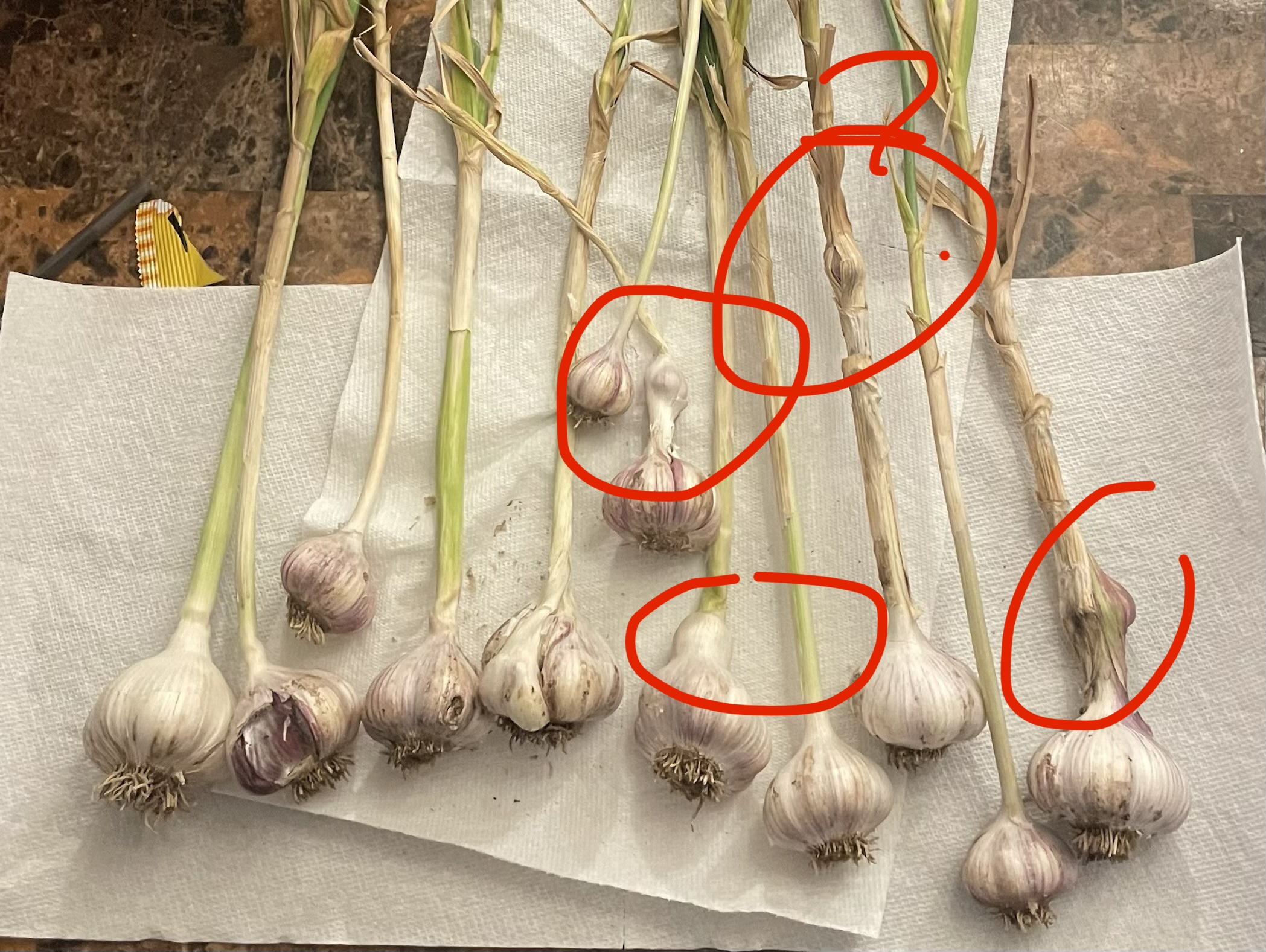
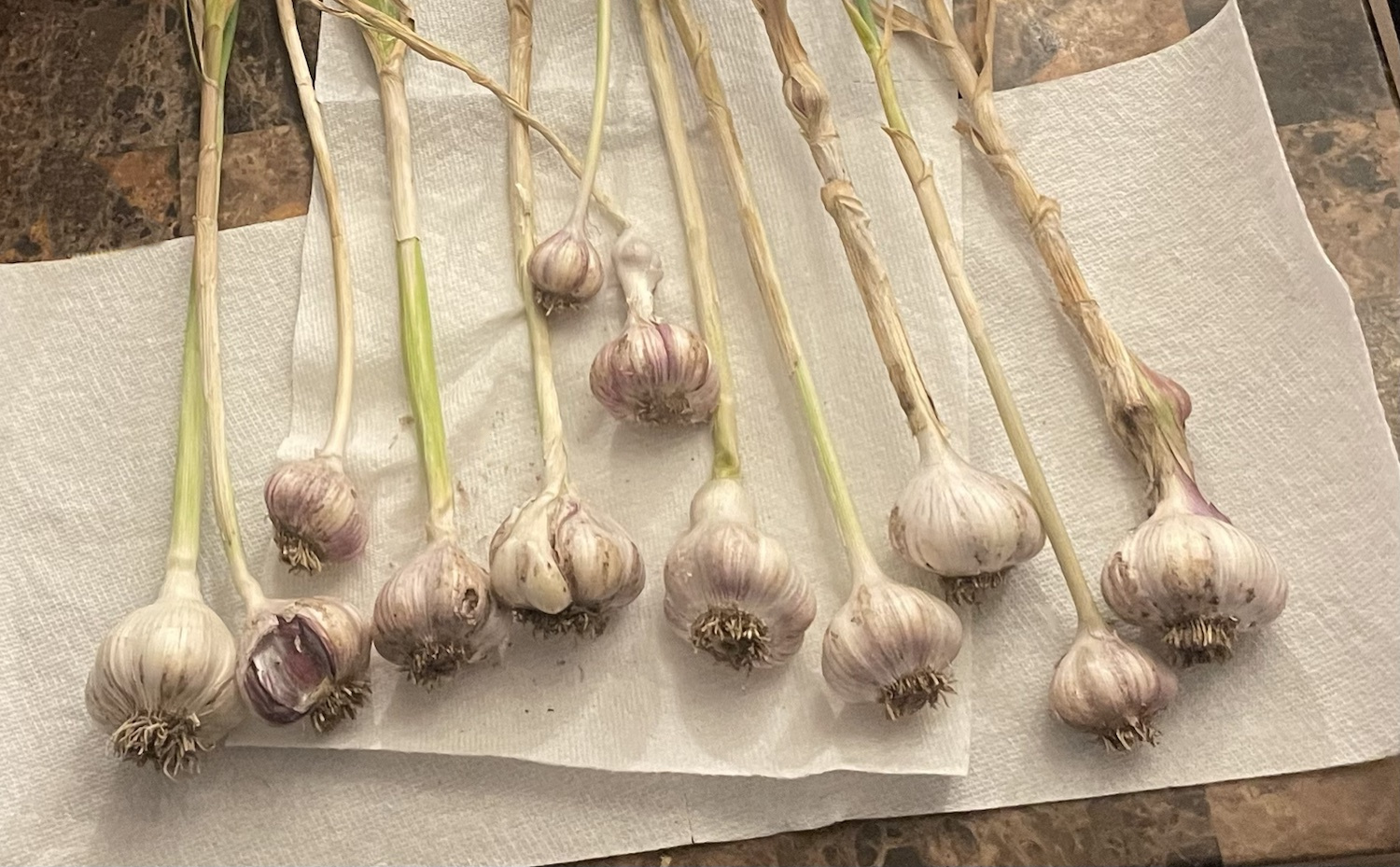
One year, I left some of my garlic in the ground a little too long. By harvest time, the protective wrappers had started breaking apart, exposing the cloves.
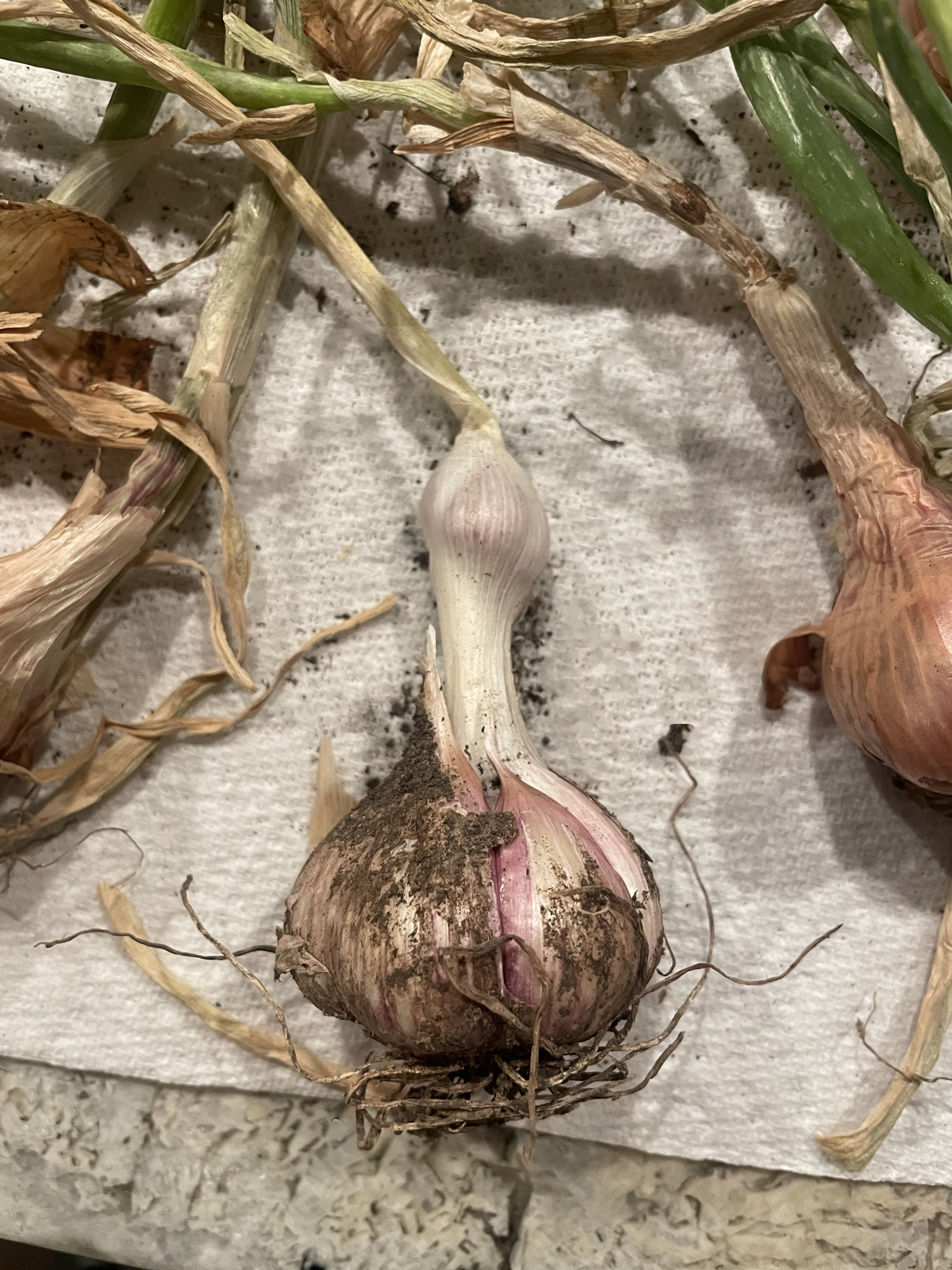
I also found something much stranger: little extra bulbs growing along the stalks, just above the main garlic bulbs underground. I'd continued watering late into the season, and I wondered whether that contributed.
These are two different issues. Late harvesting can cause garlic wrappers to deteriorate and cloves to separate. The extra bulbs appear to be secondary growth, which can have several possible causes.
What I'll do differently: Keep a closer eye on harvest readiness, taper watering as the bulbs mature, and harvest before those protective wrappers begin falling apart.
Pictured: My own garlic harvest, with splitting bulbs and unusual secondary growth circled in red.